For parents and teachers
Parents’ corner
DAHOMAN is a set of free games where you win by listening, keeping your word, helping each other and telling the truth.
This page is for grown-ups: what each game is about, a question to ask after playing, a challenge to do away from the screen, and everything we never do.
Our promises to parents
- No adsNo adverts, in the games or around them.
- No purchasesNothing to pay, nothing to unlock, no game money.
- No chatNo messages, no profiles, no online leaderboards.
- No accountNo name, age or email asked of your child.
- No cookiesNo cookies, no analytics, no tracking.
- Nothing leaves the deviceProgress and settings stay on your phone, tablet or computer.
- No random drawsNothing to win by trying your luck: everything is chosen or earned.
- 5 to 15 minutesShort games, and a clear ending after about 15 minutes of play.
What are the Dahoman about?
In Xwe, the imaginary land of DAHOMAN, every promise kept brings a small masked creature to life: a Dahoman. It only shows its face to someone who fulfils its Key, one of a Keeper’s qualities. That is the heart of DAHOMAN: you don’t win a Dahoman by force, you earn its trust. There are eight Keys.
-
Truth
In life Telling the truth, even when it’s hard. The truth can be gentle.
In the games The clues in Mask of the Day never lie.
-
Promise
In life Keeping your word and finishing what you start.
In the games In Quick Joust, the opponent sometimes says what it will play next, and always keeps its word.
-
Patience
In life Waiting your turn and trying again without getting upset.
In the games “Not yet!” replaces failure: you try again, and nothing you found is lost.
-
Listening
In life Paying attention and letting others finish.
In the games Who’s Calling? and Drum Echo are won by listening.
-
Sharing
In life Sharing your place, your water, your time; playing together.
In the games Two players share one screen in Mask Match and Drum Echo.
-
Care
In life Looking after others, animals and places.
In the games Most of the 144 Dahoman are inspired by real animals, which makes children want to know them.
-
Courage
In life Daring, creating, showing what you made, standing up for someone smaller.
In the games The quiz only describes strengths, and the printable masks are worn with pride.
-
Respect
In life Greeting people, listening to an elder to the end, giving back what isn’t yours.
In the games The Word Salute opens and closes every duel, win or not.
The games never preach: the value is in the rules. Children win because they listened, waited their turn, kept their word or played together.
The games, one by one
For each game: the age, the suggested time, the Key at work, what the game is about, a question to ask after playing and a challenge to do off screen.
-
Mask of the Day
- Age
- From 5 with pictures, 6 to 12 with names, and grown-ups too
- Time
- 3 minutes a day
- Keys
- Patience Truth
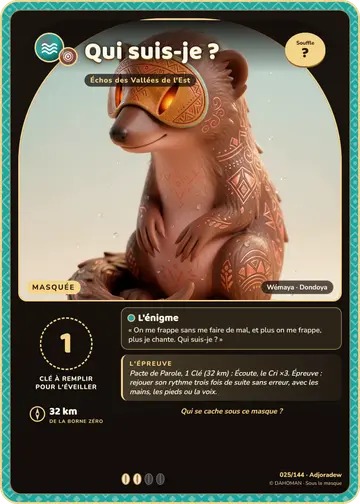
One mystery Dahoman a day, the same for everyone. With pictures, your child taps the hidden one among three, and the blurry picture gets sharper with each try. With names, every guess gives true clues: type, region, distance…
The Hint button (a magnifier) is always there. Keeper days count the days played and never go back to zero. No countdown: “A new mask tomorrow”.
After playing, ask
“Which clue helped you most?”
Off-screen challenge
Get someone to guess an animal with three true clues.
-
Mask Match
- Age
- 4 to 10, and parents too
- Time
- 3 to 6 minutes
- Keys
- Patience Sharing
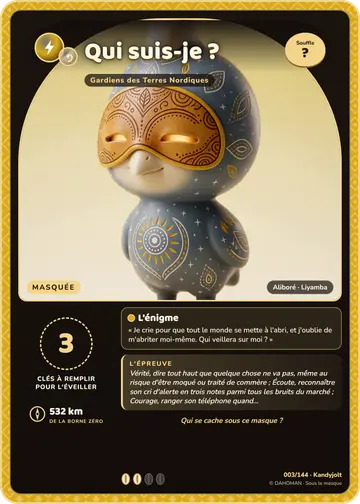
Find the pairs: on one card the Dahoman wears its mask, on the other it is awake. The type’s color and symbol help link them. The very first game, with 4 pairs, is always won.
No timer unless your child picks the Time challenge. Two players take turns on the same screen: blue hand, then orange hand. Find a pair and you play again.
After playing, ask
“How did you remember where the mask was?”
Off-screen challenge
Play the pairs game with real socks.
-
Quick Joust
- Age
- 6 to 12 (the short mode, with bars, from 6)
- Time
- 3 to 8 minutes
- Keys
- Respect Promise
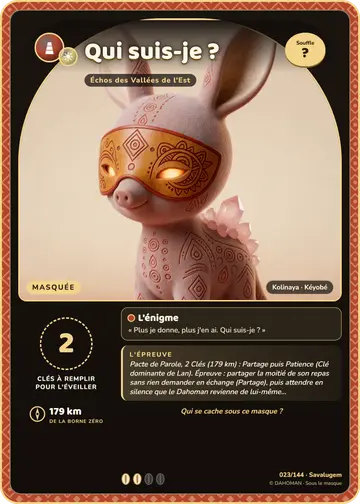
A card duel against a character from the saga: Buzz & Klik to start, Enzo the rival, then Master Varnish, sillier than scary. The opponent plays its Dahoman first and you can see its type. Your child picks one of theirs and a quality (Breath, Drive, Guard, Speed or Special). Types matter more than luck: you win by thinking.
The opponent sometimes announces the type of its next Dahoman, and always keeps its word. The Dahoman that doesn’t win the round steps back and bows. Every Joust starts and ends with the Word Salute, and a rematch is only offered after the salute. The first Joust is always won.
After playing, ask
“Why did your Lagoon Dahoman win against the Ember one?”
Off-screen challenge
Teach someone the Word Salute: two fingers on your lips, then an open palm.
-
Drum Echo
- Age
- 4 to 12
- Time
- 3 to 5 minutes
- Keys
- Listening Patience
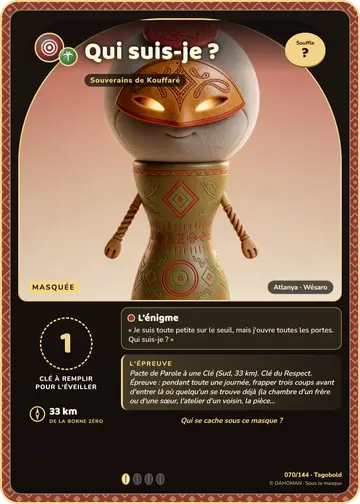
Four big drums, each held by a Dahoman. The drums play a rhythm and your child taps the same one. The rhythm grows little by little, starting with two beats. Every two echoes, a Dahoman lets its mask fall.
A mistake? “Not yet!”, and the rhythm plays again, with no scary sound. The drums light up, so you can play without sound. There is a calm mode, and a two-player mode, taking turns.
After playing, ask
“How did you remember it?”
Off-screen challenge
Tap a rhythm on the table; the other person repeats it, then swap.
-
Who’s Calling?
- Age
- 4 to 10
- Time
- 2 to 3 minutes
- Key
- Listening
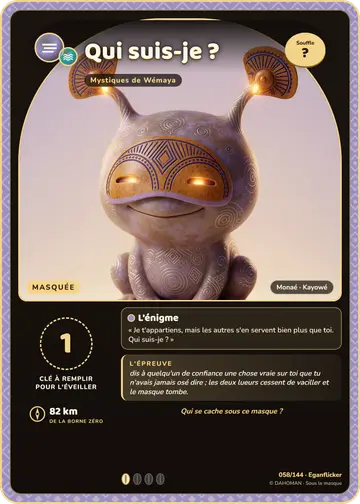
You hear a Dahoman’s Call and tap the right one among three. Each Call follows the syllables of the Dahoman’s name, one note per syllable, like clapping syllables at school.
A mistake? That choice fades and you listen again: every Call is found in the end. The Hint plays the Call more slowly and shows the type’s symbol. A silent mode lets you see the Call.
After playing, ask
“Which one had the funniest Call?”
Off-screen challenge
Make up a Call for your favorite animal.
-
Print and Make
- Age
- 4 to 12
- Time
- 15 to 30 minutes, away from the screen
- Key
- Courage
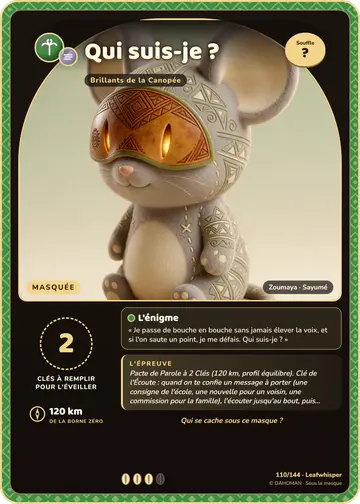
Three calabash masks to decorate, cut out and wear (half-masks sized for a child’s face), a blank “Invent your Dahoman” card and three coloring pages. On the card, you share 15 dots among 5 qualities: no one can be the strongest at everything.
Cutting out the eye holes and fitting the elastic are jobs for a grown-up. Nothing is asked and nothing is sent: we never ask for photos of drawings.
After playing, ask
“Tell me about your Dahoman: where does it live, and what is its Call?”
Off-screen challenge
Wear your mask and give someone at home the Word Salute.
-
The 144 Dahoman
- Age
- All ages
- Time
- At your own pace, 5 to 10 minutes
- Key
- Care
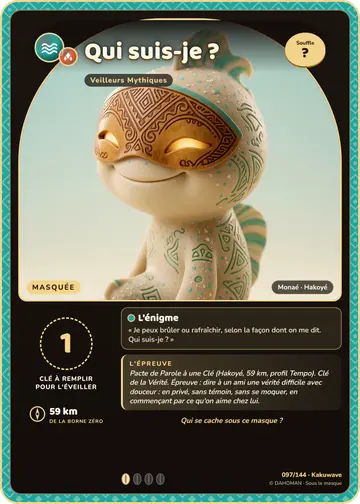
The whole collection. Tap a card and the mask falls. Most Dahoman are inspired by real West African animals: genet, marsh mongoose, aardvark, guineafowl…
After playing, ask
“What animal do you think it really is?”
Off-screen challenge
Pick up three pieces of litter outside together: it’s a challenge of the Care Key.
-
Which Dahoman Are You?
- Age
- 6 to 12 (a grown-up can read the questions)
- Time
- 2 minutes
- Key
- Courage
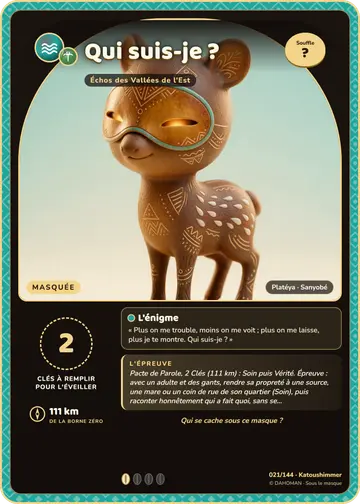
Seven questions, then one Dahoman among the 30 of Series 1. Your answers decide, not luck, and the result only describes strengths.
Answers are neither kept nor sent.
After playing, ask
“What about this Dahoman is like you?”
Off-screen challenge
Tell someone in your family one thing they do really well.
-

The Keeper’s Book
- Age
- 5 to 12
- Time
- 1 to 2 minutes
- Keys
- Promise Patience
The collection album: 144 slots, one page per region. A Dahoman steps out of the shadows when you meet it in a game, or when you scan the QR code on its card. Both ways are free: all 144 can enter the Book.
The Book stays on this device, with no account: a new phone, or clearing the site’s data, starts it again from zero.
After playing, ask
“Which one would you like to meet next, and why?”
Off-screen challenge
Choose a small promise for the week (putting your shoes away, helping set the table) and keep it to the end.
Playing together
- Two players, one screen. Mask Match (blue hand, then orange hand) and Drum Echo (taking turns).
- The Word Salute. Two fingers on your lips, then an open palm: “Word given, word kept.” It opens and closes every duel, win or not. Learn it as a family: it works for football and card games too.
- The big one’s challenge. When an older child plays with a younger one, the older one picks their own challenge: fewer cards, one try less, playing with the other hand… The younger child can win for real, and the older one is proud of the challenge.
- Play alongside. With the youngest: read the instructions, laugh at the Calls, search together. The speaker button reads instructions aloud.
Screen time
- You decide how long. The game stops by itself.
- A game lasts 2 to 8 minutes. After about 15 minutes of play in a day, the game simply says: “That’s all for today. See you soon, Keeper!” It stays open, but nothing pushes your child to keep going.
- Nothing is designed to keep children hooked: no notifications, no countdowns, no streaks to break, no flashing “One more!” button. The timer is only ever an option.
- Our suggestion: short sessions, next to a grown-up for the youngest, and preferably not right before bed.
Away from the screen
Print and Make
Masks to wear, the “Invent your Dahoman” card and coloring pages.
My Keeper challenges
A sticker chart to draw together. Your child picks three challenges a week, funny ones and kind ones: give someone the Salute, teach a friend a Call, help at home, comfort someone, tell a gentle truth. Add a sticker if you like. Nothing is won in the game.
The day’s weather
In the evening, everyone says what the weather was like in their day (sun, cloud, rain or storm) and why, without judging.
Three thank-yous
Three small things that made us happy today, and who we could thank.
The courage ladder
Something a little scary, broken into small steps. You climb one step at a time, when you’re ready.
For teachers
The games work on a classroom screen or tablet, with no accounts, no pupil data and no ads.
- Mask of the Day on the board in 5 minutes. Show the picture mode: the class suggests, everyone votes with a show of hands, and each clue is read together.
- Who’s Calling? and syllables. Clap the syllables of a Dahoman’s name (Kan-dy-JOLT), then read them.
- Drum Echo without a screen. One pupil taps a rhythm on the desk, the class repeats it.
- Quick Joust in teams. Two teams, one speaker each, the type chart on the board, and the Word Salute at the start and the end.
- The eight Keys meet skills that schools already work on: listening, cooperating, handling emotions, telling the truth.
A downloadable teacher kit is being prepared.
The cards are coming
Collectible DAHOMAN cards are being prepared. To hear about them first, a waitlist is open to adults and teens aged 16 and over; offers are for adults aged 18 and over only.
Double opt-in sign-up, one-click unsubscribe. Your email is never sold.
In the children’s range, there will be no mystery packs: you choose your Dahoman.
What we tell children
“Ask a grown-up to sign up to hear when the cards arrive.”
Data and safety
The games run entirely on your device.
What stays on the device
- settings: voice, sounds, how to play;
- scores and counters: games played, Keeper days, today’s play time (for the gentle ending);
- the Keeper’s Book: the Dahoman met so far.
Everything is kept in the browser’s local storage (localStorage), on this device only. Nothing is sent.
What we never do
- ask for a child’s name, age, email or photo;
- open an account, a chat, a profile or an online leaderboard;
- show ads or offer purchases;
- set cookies or use any measurement or tracking tool;
- send notifications, or ask for location, camera or microphone.
Voices. In French, instructions are read by a synthetic voice recorded in advance and stored on our site; in English, by the voice already installed on your device.
Sharing. It goes through your device’s share menu, and you choose who to send to. The Mask of the Day picture never gives away the answer.
One technical exception. Fonts are loaded from Google Fonts, which receives the device’s IP address. Everything is explained in the privacy policy.
Erase game data
In a browser: clear the data for dahoman.com in its settings. In the Android app: Settings › Apps › DAHOMAN › Storage › Clear data.
What we build on
Our games are inspired by research on child development. They promise no effect: they are games.
Cooperative games make young children more cooperative; competitive games tend to do the opposite. Hence our two-player modes, where you win by playing well together.
Bay-Hinitz, Peterson and Quilitch, Journal of Applied Behavior Analysis, 1994
A story where honesty is praised encourages children to tell the truth; a story where the liar is punished does not. We show what the truth brings.
Lee, Talwar and colleagues, Psychological Science, 2014
In toddlers, being rewarded for helping can reduce the wish to help later. Here, a kind act never earns points.
Warneken and Tomasello, Developmental Psychology, 2008
What children watch helps them more when a parent talks about it with them. Hence the question to ask after each game.
Rasmussen and colleagues, Journal of Children and Media, 2016
Many apps for young children contain manipulative design (rewards that keep them playing, pressure, ads). We use none.
Radesky and colleagues, JAMA Network Open, 2022
Contact and credits
A question, a comment, a concern? Write to us: masque@dahoman.com. DAHOMAN is published by GREENBRIDGE (see the legal notice).
Synthetic voice: Piper, fr_FR-siwis-medium voice, from the SIWIS French Speech Synthesis Database (CC BY 4.0 license).